Sunday, January 26, 2014

Minimalism & the Haiku

1915 "Black Square" By K. Malevich
When looking back though the pages of time nothing could seem more distant from one another than ancient Japan and the American 1960s. But when taking a closer look, there is actually more in common than one might consider...

In thirteenth-century Japan a movement occurred that would change the world of verse: the haiku. It was in the thirteen-century that the haiku first appeared as the opening phrase of an oral poem called renga, traditionally consisting of 100 stanzas composed syllabically. Later, in the sixteenth-century, the haiku, being much shorter than the renga, broke away completely as a stand alone form of verse. The haiku would later become mastered by Matsuo Basho in the next century.
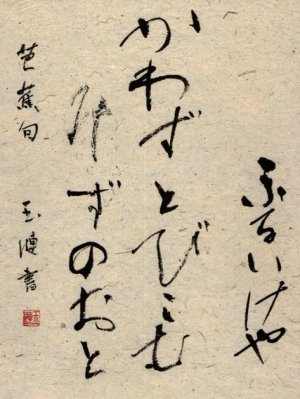
The Traditional Japanese haiku consists of three lines of seventeen syllables in a 5/7/5 arrangement. These small, simple verses often focused on nature, emphasizing simplicity, directness, and intense images
1686 Haiku By Matsuo Basho
often juxtaposed in colourful and unique ways. Some of the greatest haiku poets include Yosa Buson, Masaoka Shiki, and Kobayashi Issa.
The idea and philosophy of the haiku is still around today and embraced by many modern poets including Robert Haas, Paul Muldoon, and Anselm Hollo.

Minimalism came into being in the early 1900s when Kasimir Malevich created a unique painting of a simple black square on a plain white background. It was this painting that set the Minimalist movement in motion.
Many different artists argued about the proper medium, materials, and messages that Minimalism needed to communicate, and in the 1960s it found its voice in Pop Art. Minimalism was to focus solely on the art itself, separating the artist's ego and any influence that the art might have on the viewer; Minimalist art should not speak to the observer about hidden messages to be discovered through clever tricks and analysis, it was to simply be a visual experience for the observer, the object as it is an object and nothing more. Some of the most well known Minimalist artists include, Dan Flavin, Tony Smith, Al Held, and Donald Judd.

1969 "Untitled" By Donald Judd
So how do Minimalism and haiku poetry meet? In their simplicity of expression. Both Minimalist art and haiku poetry express qualities of simplified directness and elegant juxtapositions on what expression really means. At their core, both Minimalism and the haiku set out to express grand schemes in the simplest means as possible. Both the haiku and Minimalist art are about the same thing: the experience and the expression. Minimalism is about the object itself, separate from any external modifier, while the haiku explores the grand in its simplest form, cutting out all the unnecessary to get to the center of what is being expressed. In the end, the haiku itself is about the image, or more so the word than the poem, a triumph of the simple over grand. Ezra Pound put it best as, "The image itself is speech. The image it the word beyond formulated language." This philosophy holds true for both Minimalism and the haiku.
Matsuo Basho

Friday, December 6, 2013

Art & Literature at the Turn of the Century: Breaking the Mold

      At the turn of the century the world was set on a cliff, poised to embrace a new chapter in history. The turn of the century offered a closure to old world ideals and beliefs, opening a new door to industrial expansion and life apart from restriction, expectations, and oppression. All of life was thrown off that cliff, or perhaps jumped with open arms, and likewise art and literature led the way.

      At the end of the Victorian era, thought had changed. This was the end of agricultural life and a shift to a more industrious society. There was a rapid change in what was consider moral and appropriate, as well as a shift in religious thought and practices. It would seem that the repressive and restrictive Victorian idealism had driven some to the brink, and now they were braking free.
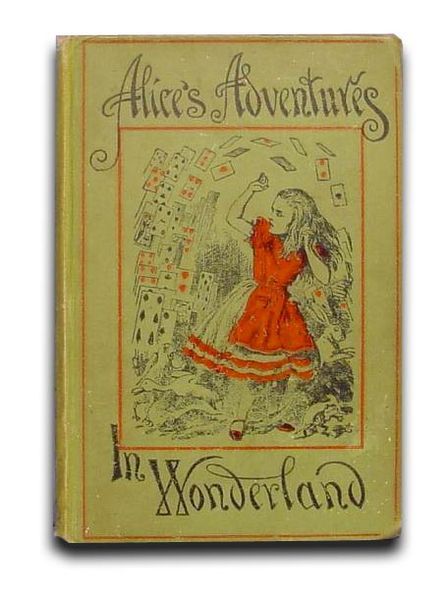
      Starting in the 1870s, writers began to refuse moral representation, preferring their new brand of light. This often took the shape of a rebirth in prose fantasy. Such works as Robert Lewis Stevenson's The Strange Case of Dr. Jekyll and Mr. Hyde in 1886 and Lewis Carroll's Alice's Adventures in Wonderland in 1865 display this return to the imaginative and fantastic.
Charles Darwin
      Along with the attack on morals and tradition, marriage and the roles of women also came under scrutiny. The Victorian woman was quite oppressed, not
only in her roles as a wife and woman, but also in her way of dress, speech, and manner. All of this was considered invalid during the braking away from tradition. During this time, more and more female writers receive attention, and the idea of women in society was altered completely.
      With the publication of Charles Darwin's Origin of the Species in 1859, the religious world was turned on its head. Some writers took aim on religious subject-mater and attacked old-world ideals. Thomas Hardy was particularly influenced by this schism.

      Along with writers, artists too began to rebel against old-world idealism and
1905 "Open Window, Collioure" By Henri Matisse
tradition, adjusting to this new and industrious society. Ever since the development of the camera in the 1800s, art had been shifting. With the creation of photography, art was forced to preserve itself by adapting new styles and techniques to cope with the shift in fast paced growth of society. Photography threatened to extinguish art as it grew more advanced; the camera could capture an image much quicker and cheaper than could an artist capture the same image. This put many portraitists out of business, replaced by portrait studios. This inspired artists to revert to a more dreamy state of mind.
      Since the camera could now capture images quickly and accurately, art decided to capture images in fuzzy and fogy representations of life. We see this change with Expressionism and Impressionism. These differing styles took images and contorted them into hazy visions that seemed "out of focus" to some.
1907 "Les Demoiselles d'Avignon" By: Pablo Picasso
      The art world continued to shift as time went on, especially in the art capital of world, Paris. The Salon in France is a showing based on traditional ideals. But when Henri Matisse entered the scene, all this changed. Matisse led a short-lived movement known as Fauvism in the early 1900s. This movement would span a whole new generation of abstract artists and movements. Fauvism, labeling the movement as the art of "wild beasts," took shape as a while and passionate use of color in unpredictable and new ways. This wild use of color broke down all expectations of what art is and what it can accomplish. The Fauvism movement would later in inspire such artists and movements as Picasso and Cubism, Duchamp and Dadaism, and Dali and Surrealism.
      With new technologies also came new mediums of art. When the camera hit the scene, some artists began to ponder the artistic potential of the new device. It would take several decades for photography to become recognized as a legitimate form of art however. Very few people - very few artists - acknowledged photography as an art form, but with the rapidly
changing state of the world, photography eventually became a recognized medium of artistic expression in the twentieth century. This new medium was embraced by such artists as Alfred Stieglitz, Holland Day, Julia Margaret Cameron, Charles Lutwidge Dodgson, and Oscar Gustave Rejlande.

1931 "The Persistence of Memory" By: Salvador Dali
      With the changing world at the turn of the century, art and literature team up once again to focus the ideals of a society in change, giving a new voice for all to hear.

Monday, November 25, 2013

Presidential Portraiture

     Before the development and widespread usage of the camera, portraiture was the only way to capture a person's image. For centuries portraits were only available to the very wealthy, such as royal families or aristocrats; and since 1789, the list has included U.S. Presidents.
      For decades many people could only see their president though portraits, busts, stamps, and the like, there were no photographs or television specials to show what the president looked like. When it comes to depicting a nation's leader, there is little room for error; only the most skilled and professional artists come to produce true likenesses of their leaders. For a presidential portraitist, the task of capturing the President is no small matter.

      When it comes to presidential portraiture,there are many factors that play into how the image should taken on and captured. The most important factor is of course mood. What mood should be conveyed in the portrait? Some presidential portraits show the President as a strong figure while others show a more comfortable and compassionate persona. All of these moods need to be appropriate to the President as these portraits show the nation their most elite officer or leader; the President is not only a figurehead, but someone the nation turns to in crisis, and the image of the President is very crucial.

1800 Thomas Jefferson By Rembrandt Peale

      This portrait of Thomas Jefferson by Rembrandt Peale depicts the President as a compassionate and learned man, capable of greatness yet still only human. Jefferson's face is stern and serious, yet his eyes are soft and inviting. His brow is set and shows that Jefferson is man of intellect and great wisdom. The President is dressed in  serious black, though there is a soothing, pale light peaking from behind his shoulders, giving him an overall gentle feel.

1884 Rutherford B. Hayes By Daniel Huntington

      Here, the President, Rutherford B. Hayes, is portrayed as a very serious man and a very serious President. Hayes is standing in a very strong pose, his eyes set straight ahead, and his demeanor is fierce. One arm is at the President's side while the other is positioned on a stack of papers, showing that the President means business.

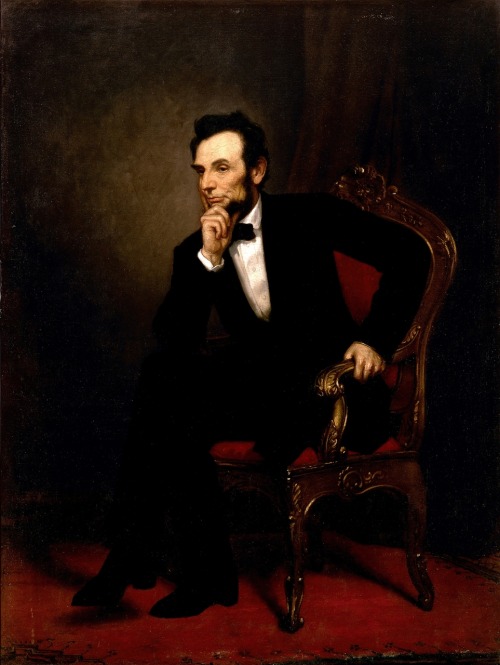
1869 Abraham Lincoln By P. A. Healy

     This strong portrait of Abraham Lincoln, painted by George P. A. Healy, captures the President in a grim and dire air. Here, Lincoln is caught in deep though, sitting in a regal armchair. The President looks so lost in thought that he is looking away to the side, his hand on his chin. The dark shades of brown, black, and red give the portrait a gloomy atmosphere. This dark portrait is befitting to this president considering his term during the Civil War, and his assassination. P. A. Healy had captured President Lincoln as a strong and thoughtful man.

      Portraits of the American Presidents were very important back in their day, and remain important today. Without these portraits, the American people may never have known the face of their President.

Here are a few of the other Presidential portraits:

1835 Andrew Jackson By Ralph E. W. Earl
1895 Benjamin Harrison By Eastman Johnson
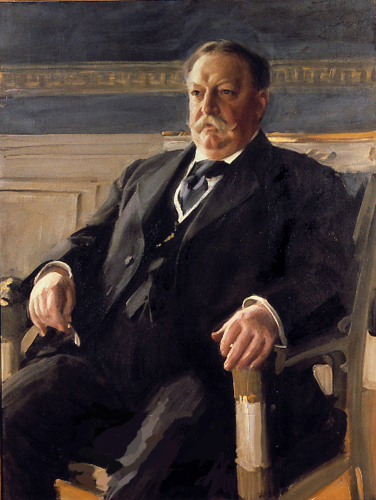
1911 William Howard Taft By Anders Zorn
1947 Harry S. Truman By Martha Greta Kempton
1970 John F. Kennedy By Aaron Shikler

Thursday, November 21, 2013

Paul-Gustave Doré: Engraving the Dreamscape

 
From The Bible
     Paul-Gustave Doré, or simply Gustave Doré, was the premier printmaker and engraver of the mid-to-late 19th century. He is the most famous, if not the best engraver of the century. He is most well known for his illustrations in The Divine Comedy, The Inferno, and Don Quixote. Though Doré was also a
sculptor and later a painter, he is most well known for his vivid and imaginative woodcuts depicting gruesome and horrific scenes depicted in the books they represented.

      Gustave Doré was born in Strasbourg France in 1832 (died in Paris, 1883). Throughout his lifetime, Doré made a living through his art by printing in local journals and papers. But he would not see fame and recognition until he moved to Paris in 1847. Doré would work making weekly lithograph caricatures for the Journal pour Rire from 1848-51. From this platform, Doré would launch his life into the fame that take him.
From The Inferno
      In his lifetime, Doré would come to illustrate some 90 books (though some suggest the number of illustrated books could number up to 200 or more). Most of the work Doré would produce centered around historical and religious texts. His style and taste was a slight bit morbid, as he had a passion and interest in the macabre and grotesque. This style connected with the epic, dark, and dreamlike Romantic writers. Doré's art can be found in such works as The Divine Comedy, The Inferno, Paradise Lost, The Raven, The Rhyme of the Ancient Mariner, Fables de La Fontaine, and even The Bible.

      Gustave Doré was giving visions to literature, bringing to life the books that he touched. Doré took the images set fourth by great writers and gave them wings on which to fly and mouths for which to breath. Doré's engravings give a new voice and a new depth to literature, setting free the dreamlike images within the pages.

From Fables de La Fontaine

From The Rhyme of the Ancient Mariner
From The Raven
From Paradise Lost